for coaches
Follow Up With Leads: Why Coaches Quit After One Message
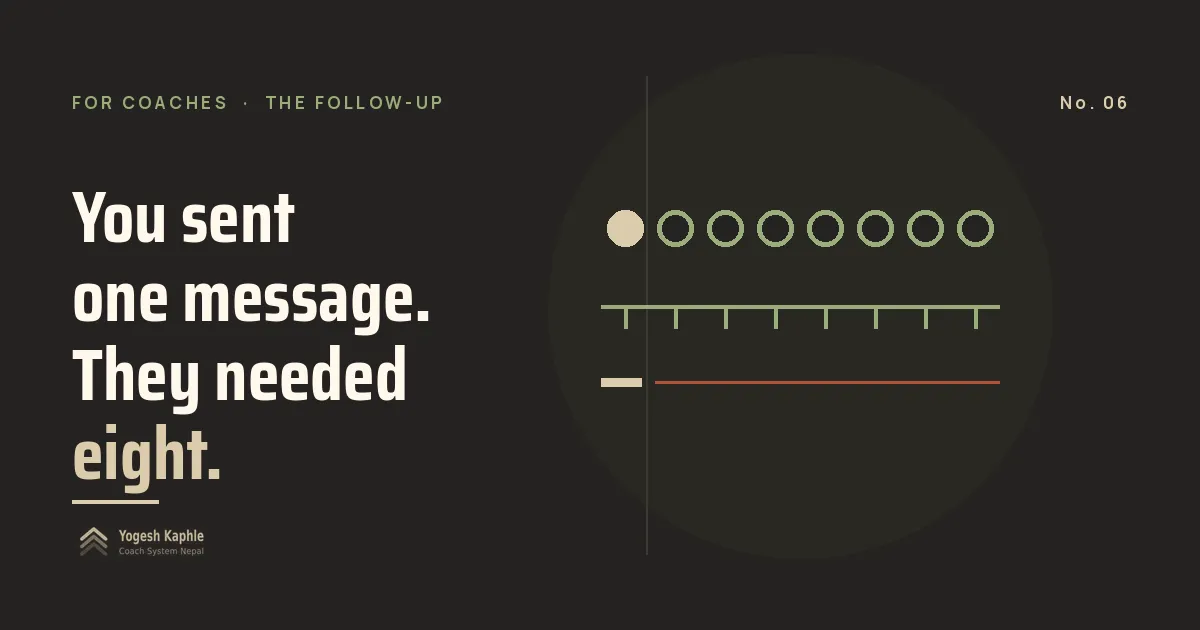
TL;DR: Your leads are not cold. They are unfinished. The person who messaged you “price kati ho?” was not saying no. They were saying not yet. Most coaches read the silence as rejection, close the chat, and write the lead off. The buyer never said no. They just needed more than one moment to decide, and you were not there for the rest of them. This is where your pipeline leaks.
The message comes in on Viber. Sometimes WhatsApp. Sometimes an Instagram DM at 11pm.
“Coaching ko cost kati ho?”
You reply properly. The package, the structure, how long it takes. Maybe you send a link to a client result, because you want them to see this is real.
You hit send.
Seen.
Two minutes. Two hours. Two days. Nothing.
And that invisible reply, the one that never comes, is louder than any message they could have sent. So you close the chat. You tell yourself the thing every coach tells themselves.
If they were serious, they would have replied.
That sentence has cost you more money than any bad post ever has.
Why don’t leads reply after the first message?
Because one message is an announcement, not a decision. Your lead did not go cold. They went quiet, which is a completely different thing, and almost every coach reads it wrong.
Think about what is happening on their side of the screen while you are staring at Seen.
They are comparing you to two other coaches. They are doing the maths on their salary. They are wondering if they can actually show up three times a week. They are asking themselves whether they trust you enough to hand over their body, their food, and their mornings for the next six months.
None of that happens in the ninety seconds after your price message.
Silence is not rejection. It is deliberation.
The myth that keeps your pipeline empty
The belief goes like this: if they were really interested, they would have replied the first time.
It is wrong. It is also comfortable, which is why it survives.
That belief hands the blame to them. They were not serious. Bad timing. Tyre-kicker. It protects your ego from a much harder thought, which is that the lead was real and you left before the conversation finished.
Buyers do not move on one pitch. A pitch is a moment. A decision is a process. And that process takes days or weeks, during which you are either present or forgotten.
How many times should I follow up with a lead?
More than once, and far more than you are comfortable with.
RAIN Group studied 489 sellers and found it takes an average of eight touchpoints just to land a first meeting with a new prospect (RAIN Group). Eight, before the real conversation even begins.
The email data says the same thing from another angle. Across an analysis of more than 20 million cold emails, sequences of four to seven messages pulled roughly a 27% reply rate. Sequences of one to three messages pulled about 9% (Cirrus Insight).
Three times the replies. Same offer. Same person. The only variable was whether someone stayed.
Now count your own follow-ups.
One. Then silence. Then you moved on, and quietly decided the market in Nepal is cheap.
The market is not cheap. You left the room.
Here is the same idea, told backwards.
Touch 8: they message you. They are ready. They ask how to start.
Touches 1 through 7: you were there. In their feed. In their inbox. In their head. You did not pitch every time. Most times you did not pitch at all. You just refused to disappear while they made up their mind.
One touch is an announcement. Eight is evidence.
The shame spiral that kills follow-up
It is not laziness. I want to be clear about that, because most advice on this treats coaches like they are lazy and they are not. Three things collide.
It feels like begging. You send a second message and a voice in your head says you are bothering them. They did not reply. Take the hint. That voice is shame, not strategy. You were raised to respect a closed door, and an unanswered message feels like one.
You have no system, so every follow-up is a fresh emotional decision. There is no sequence running. No reminder. Nothing scheduled. Every single follow-up lives in your hands, right now, and every time you open that chat you relitigate the whole thing. Should I? Will I look desperate? Emotional decisions exhaust you far faster than process decisions do. By the third one you have already quit, and you have not even sent the second.
You are coaching all day. Fifteen, twenty, thirty hours a week on the gym floor. Then programming at night. Follow-up feels like admin, not like income, so it slides to tomorrow. Then next week. Then never.
Every one of those is real. I have felt all three.
The coaches who convert are not the ones who stopped feeling the shame. They are the ones who stopped letting a feeling decide whether a message gets sent. That is the whole difference, and it is a system difference, not a character one.
What staying in front actually means
Following up does not mean pestering. Nobody converts because you wore them down.
Staying in front means the person keeps encountering you while they decide. Your name. Your thinking. Your face. Not as a nag, but as a presence.
So when a lead goes quiet after your price message, the follow-up is not “any update?” Nobody has ever replied to “any update?”
It is a story about someone in exactly their situation who was stuck the same way. It is an answer to the question they were too embarrassed to ask. It is one specific observation about their training that proves you were actually paying attention.
You are not chasing. You are being useful, on a rhythm, while they think.
By the time they are ready, buying from you is the obvious move. Not because you convinced them. Because you were the only one still there.
This is Step 3 of the 5-step system I use to get coaching clients online, and it is the step almost every coach skips entirely. It is also why the same person can watch your content for a year and never message you, which I unpacked in why your followers like everything and buy nothing.
The follow-up that landed my first client
I watched him for months before I said anything.
His content. His training. The way he approached his craft. I never commented. I never slid into his DMs looking for an opening. I was just paying attention, learning his world properly, so that when I did speak I would have something real to say.
When I finally messaged, I did not lead with what I wanted. I led with something specific I had noticed. Not “great content bhai.” A real observation about his approach that only someone who had actually been watching could have made.
It was not a pitch. It was recognition.
He went quiet for four days.
The old version of me closes that chat. He is not interested. Move on. Do not embarrass yourself.
But by then I understood that silence is not a verdict. It is a pause. He was busy. Or thinking. Or he read it, meant to reply, and life happened, the way it happens to all of us.
So I went back in. Not with “just checking in.” With something real, aimed at his work, not my need. Something worth opening.
That one landed. He replied. The conversation opened up properly. He became my first paying client.
The whole business turned on the gap between message one and message two. Most coaches never cross that gap. That is genuinely the only thing I did differently.
Key Takeaways
- Silence after your first message is not rejection. It is deliberation, and most coaches read it as no and close the door.
- It takes an average of eight touchpoints to land a first conversation. Most coaches send one and call the lead dead.
- Email sequences of four to seven messages get roughly three times the replies of sequences of one to three. Same offer, different persistence.
- The shame you feel sending a second message is real. A system is what stops that feeling from deciding whether the message gets sent.
- Follow-up is not nagging. It is being useful on a rhythm while someone makes a decision they need time to make.
Your move
You are sitting on leads right now who went quiet. Real people who asked a real question, got your answer, and never wrote back.
Most of them are not cold. They are deciding. And a good number of them would have said yes if you had still been there when they finished.
The business is not built on the first message. It is built on the sixth.
If you want to see where your leads are actually leaking, send me your setup. Your content, your lead flow, whatever follow-up you do or do not have. I will find the one thing costing you the most clients and show you, no charge and no pitch. What you do with it is up to you.
And tell me one thing in the comments: what is the longest you have ever followed up with someone before they finally said yes?