for coaches
How Do You Get Coaching Clients Online? 5-Step System
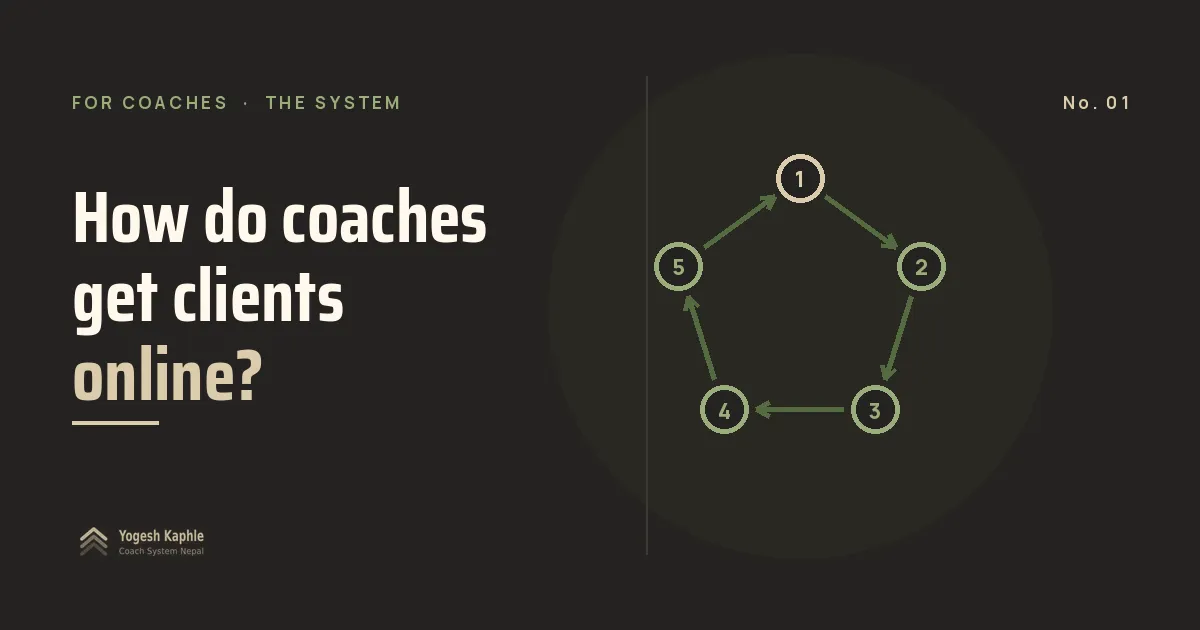
TL;DR: You get coaching clients online with a system, not with more posts. This is the 5-step loop I use to turn viewers into paying clients: know your person and the win they want, reach them, stay in front of them, help them say yes, then keep them winning so they send you the next three. It works on a small audience because it does not depend on going viral. Fitness coaches in Nepal are the proof here. The map is the same for any coach.
A coach in Kathmandu messaged me last year. Six months of reels. Workout clips, meal tips, the occasional face-to-camera pep talk. His numbers looked fine. A few hundred views. Some likes. Every week or two, a “great content bhai” in the comments.
His bank balance had not moved.
He thought his content was the problem. It was not. He was doing one thing well and four things not at all.
Why posting is not a client-getting strategy
Posting is not a business. It is posting. The coaches who sign clients every month are not posting more than you, and many post less. They run a system underneath the content, and the content is only one part of it.
Look at the math and the panic makes sense. Organic reach keeps sliding. For most accounts it now sits in the single digits, which means a post you sweated over reaches maybe 5 to 10 of every 100 followers (Hootsuite, 2026). So you post harder. More reels, more frequency, more late nights. Same silence.
More posts cannot fix a broken system. It just puts more strangers in front of a page that was never built to convert them.
The fix is a loop. Five steps. I call it the 5-step coach system, and the word “loop” matters, because step 5 feeds back into step 2. A won client becomes the proof that gets you the next one.
Here is the whole map before we walk it.
| Step | What it does | You’re done when |
|---|---|---|
| 1. Know your person and their win | Pick one person, one problem, one offer | You can say it in a single sentence |
| 2. Reach the right people | Get attention on the street, capture the lead | One source running hard, every lead captured |
| 3. Stay in front of them | Follow up until they are ready | Every lead on a rhythm, not forgotten |
| 4. Help them say yes | Turn a warm lead into a paying client | Yes plus payment plus a start date |
| 5. Keep them winning | Deliver the result, earn the referral | Client hits their number, sends you the next |
One action: stop counting likes. Start counting where people fall out of these five steps.
Step 1: Know your person and the win they actually want
The first step is not content. It is choosing one person and the one win they would pay real money for.
“I help people get fit” is a wish. It targets everyone, so it reaches no one. Pick one person. The busy professional in Kathmandu sitting eight hours a day. The new mum who wants her energy back. Then find the win they say they want, and the deeper one they actually want underneath it.
They say “more leads.” They want to stop depending on luck. They say “lose weight.” They want to stop feeling embarrassed at their own gym. Sell to the deeper one. Everyone sells the surface.
Then shape one offer around that win. Specific beats vague, every time. “Lose 7kg in 60 days without giving up dal-bhat and momo” lands harder than “get fit,” because a real person can picture it.
One action: finish this sentence before you write another post. “I help [one person] get [one specific win] without [the thing they fear].” If you cannot fill it cleanly, everything downstream leaks.
Step 2: Reach the right people, and close them in the right place
You reach people two ways. They find you through content and ads, or you find them through outreach. The move most coaches miss is the geography underneath both.
Social media is the street. Public, loud, built for scrolling. Your website or your DMs or WhatsApp is the office. Private, quiet, where a person actually decides. The rule is short. Meet on the street. Close in the office. Never try to close on the street.
Your content does the first job, grabbing attention, and a second job most people forget, building trust over time. But attention on the street is rented. So every post needs a walk, a way to move an interested stranger off the platform and onto a list you own. That handoff is the capture, and it matters so much it gets its own post on getting their contact off Instagram before the app buries you. The office that receives them matters too, which is the difference between a website and a landing page.
One action: pick one channel. One. Work it hard every single day for a month, and make sure every interested person has a way off the street.
Step 3: Stay in front of them (the step almost every coach skips)
Most coaches pitch once, hear nothing, and vanish. The money was in the follow-up they never sent.
A stranger rarely buys on the first ask. Buyers usually need several touches, often seven or more, before they say yes. Most coaches send one. That gap is where warm leads go cold, and it is the single most expensive habit in this whole business.
Staying present is not nagging. It is showing up on a rhythm with something useful. A small free win. A piece of proof. A story. You are waiting for the ready signal, the moment they reply warm, or ask the price, or click the booking link. That is your cue to move. If you want the deeper version of why interested people still do not buy right away, I wrote it up in why your followers like everything and buy nothing.
One action: every lead gets followed up at least three times, spaced out, before you write them off.
Step 4: Help them say yes
You are not pitching a stranger at this stage. You are helping a ready person decide.
Treat the conversation like a diagnosis, not a sales pitch. Ask before you tell. Understand their exact situation, then show how your offer solves that specific problem. When an objection comes, remember it is usually fear wearing a costume. “Too expensive” is often the fear of risk. Answer the fear, not the words. A guarantee calms risk. A split payment calms money friction better than a discount ever will.
And a yes is not a good feeling. A yes is a payment and a start date. Anything softer is a maybe.
One action: on your next consult call, spend the first five minutes only asking questions.
Step 5: Keep them winning
The sale is the starting line, not the finish. Keep the client winning and they become your best marketing.
Deliver a fast first win inside the first 24 hours. A small early result builds momentum and proves you are the real deal. Then run delivery so it does not drown you, through what I call the three Cs. Curriculum does the repeatable teaching. Community carries the daily motivation. Your actual coaching becomes the high-value part, accountability and course-correction, not answering the same question forty times.
My first paying client came from running exactly these steps in order. No audience, no portfolio, no post that blew up. Just a clear read on the one problem nobody else was naming, and a system underneath it.
This is where the loop closes. A winning client hands you three things: proof that feeds step 2, a case study that feeds step 4, and referrals that feed step 2 again. One client, run well, quietly builds the next five.
One action: map out the first task you will send a new client within 24 hours of their yes.
How do you get coaching clients online without going viral?
You get coaching clients online without going viral by running a loop, not chasing a moment. Every step above works on a small audience, because none of it depends on the algorithm handing you a lucky day.
A coach with under 1,000 real followers who runs all five steps will out-earn a coach with 50,000 followers who only does step 2. Attention is the cheapest part. The system around it is the whole game.
That is the point of building this as a machine you own. No viral moment required. No 10,000 followers needed. Just the five steps, running on repeat.
Key Takeaways
- Posting is one step out of five. Doing it well while ignoring the other four is why views go up and income stays flat.
- The order is fixed: know your person, reach them, stay in front of them, help them say yes, keep them winning. Skip a step and the system leaks.
- Meet people on the street, close them in the office. Nobody signs a coaching contract mid-scroll.
- The money is in the follow-up. Buyers need several touches; most coaches send one.
- It runs as a loop. A won client feeds proof, case studies, and referrals back into the top, so a small audience compounds.
Which of these five steps is the one you keep skipping? Drop it in the comments. I read every one.